
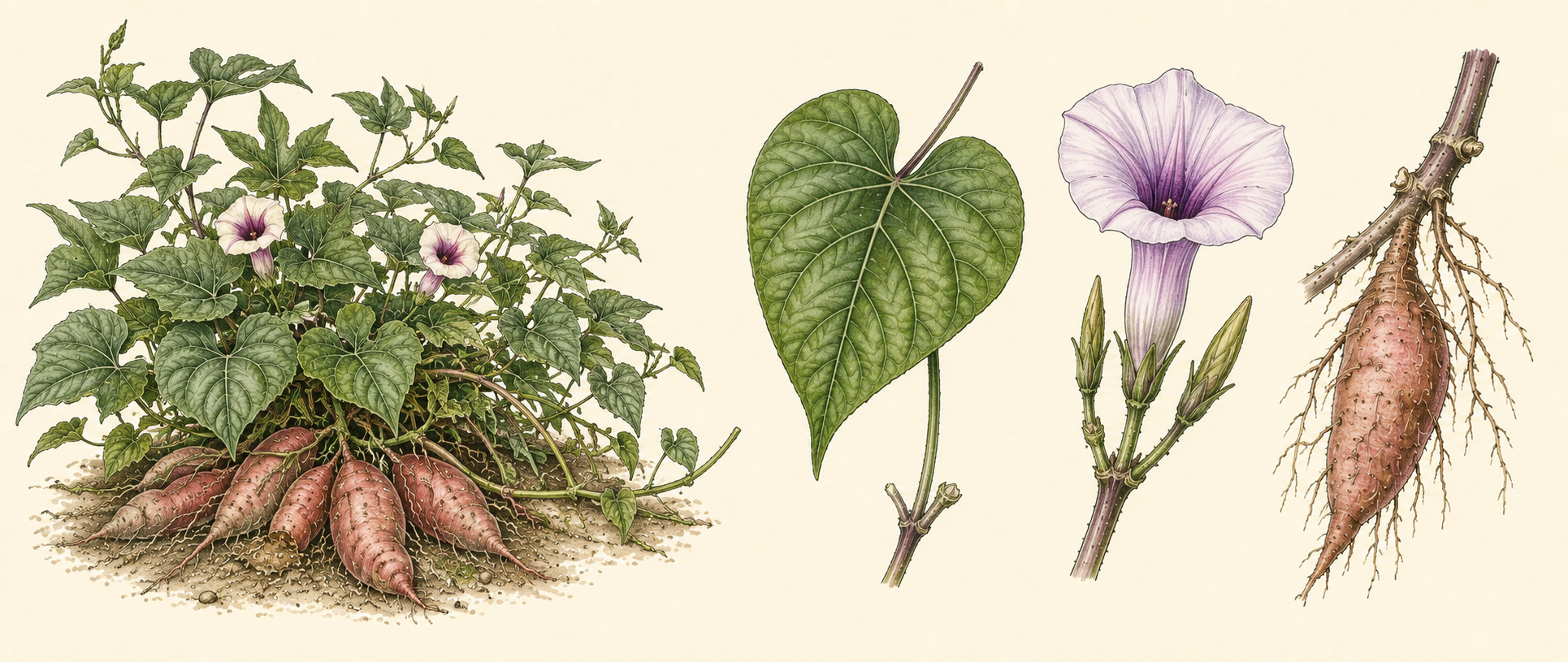
Growing
- Forest layer: Herbaceous groundcover-vine.
- Growth habit & lifespan: Fast-growing, perennial in frost-free areas (grown as an annual in cooler climates), a sprawling vine that roots at its nodes.
- Size: Trails 2-4m or more, forms a dense low mat.
- Site preference: Full sun, well-drained fertile soil, drought tolerant once established.
- Water needs / drought tolerance: Drought tolerant once established.
- Fruiting / flowering season: Occasional morning-glory-like flowers — grown mainly for the tuber, not the flower.
- Propagation: Slips (rooted cuttings) or vine cuttings pressed into soil.
- Harvesting technique: The tuber is the main harvest; the leaves and young shoots are also edible and nutritious.
Permaculture Function
- Permaculture functions: An extremely effective living mulch and groundcover that also produces a genuine staple food crop, vigorous enough to outcompete most weeds once established.
- Wildlife value: Minor.
- Edibility / medicinal use: Yes — tuber, leaves, and shoots are all edible.
- Companion notes: An excellent living-mulch groundcover under a young food forest canopy while trees establish, but vigorous enough to need clear boundaries so it doesn't climb over smaller neighbouring plants — a vigorous species worth siting deliberately rather than letting it spread unchecked.
Safety & Control
- Toxicity: Not toxic. A different genus and family from potato (Convolvulaceae, not Solanaceae), so it doesn't carry the solanine caution that applies to green potato tubers.
- Control method: Not applicable, retain and encourage, though it benefits from a defined bed or clear boundary given how vigorously it spreads.