
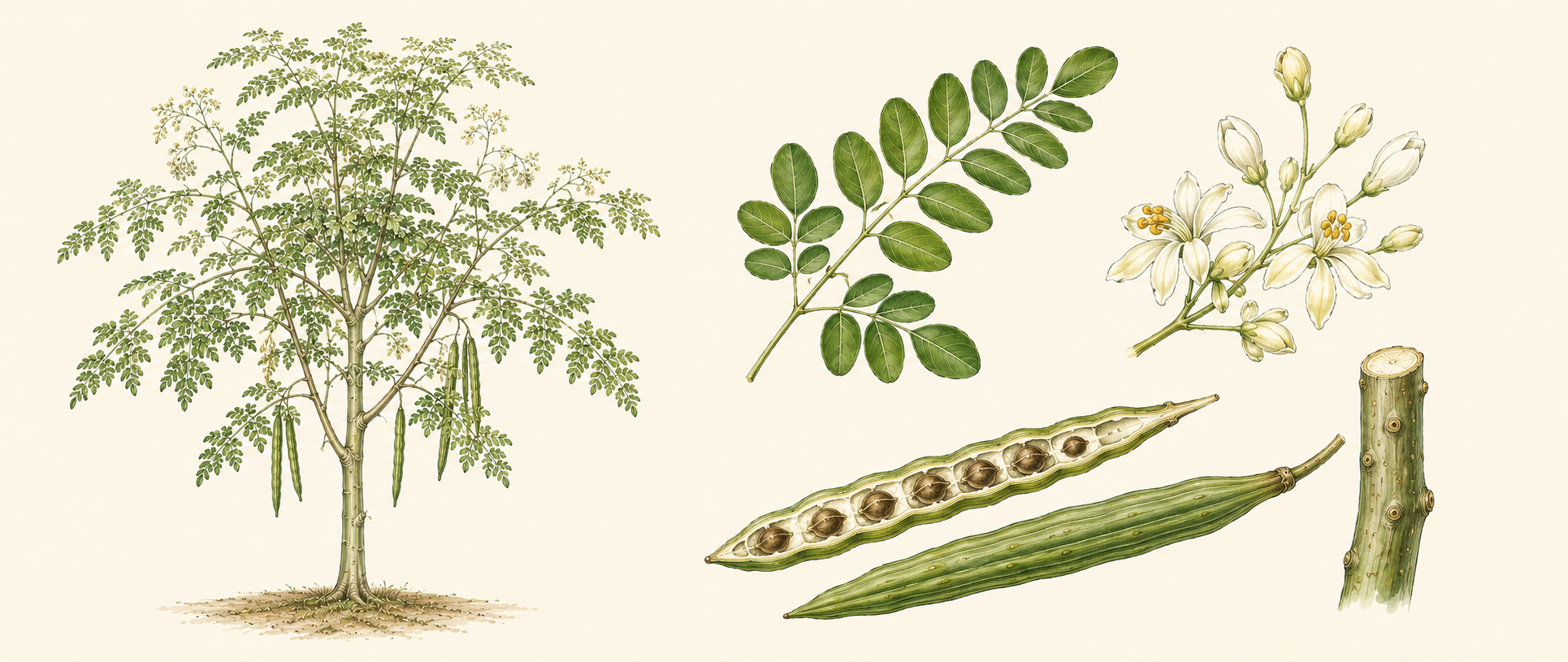
Growing
- Forest layer: Small tree.
- Growth habit & lifespan: Extremely fast-growing, semi-deciduous, frost tender — usually killed back or killed outright by a hard frost, though it often regrows from the root in mild-frost areas.
- Size: 5-10m if left unpruned, but commonly coppiced or pruned hard to stay shrub-sized for easy harvest.
- Site preference: Full sun, well-drained soil, drought tolerant once established, frost tender particularly when young.
- Water needs / drought tolerance: Drought tolerant once established, doesn't like waterlogged ground.
- Fruiting / flowering season: White flowers, followed by a long pod ("drumstick").
- Propagation: Seed, or cuttings — grows very readily from a large branch cutting pushed straight into the ground.
- Harvesting technique: Leaves (extremely nutrient-dense) and pods are the main harvest; the root has a horseradish flavour but is used with caution.
Permaculture Function
- Permaculture functions: One of the fastest ways to produce nutrient-dense edible biomass, coppices well for repeated leaf harvest, and its nitrogen-rich leaf drop makes excellent mulch.
- Wildlife value: Flowers attract pollinators.
- Edibility / medicinal use: Yes — leaves and pods are a genuine, significant food source. The root is used with caution, since some compounds in the root bark are considered unsafe in quantity.
- Companion notes: Worth siting in the warmest, most sheltered spot available on a property with any real frost risk, given how frost tender it is.
Safety & Control
- Toxicity: Root bark contains compounds best avoided in quantity. Leaves and pods are safe and genuinely nutritious.
- Control method: Not applicable, retain and encourage — but coppice hard for a manageable size and easy harvest.