
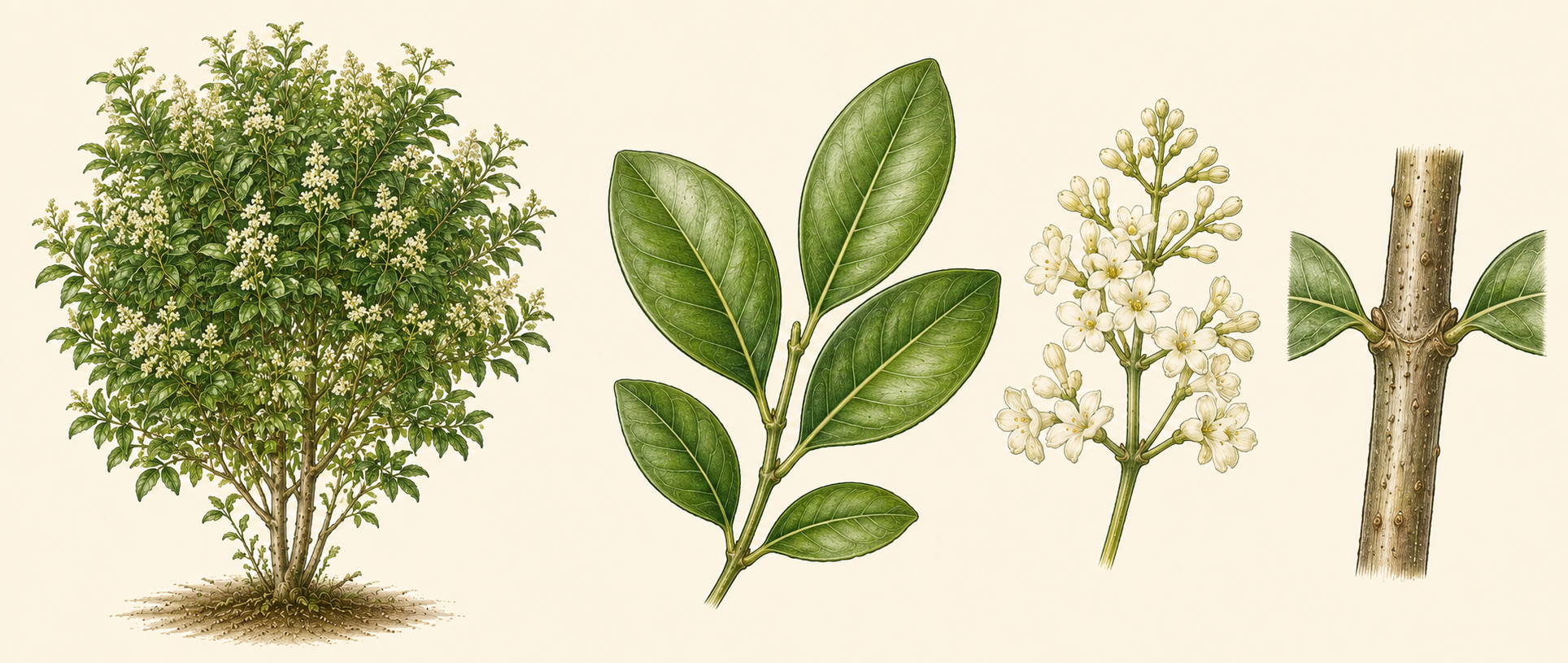
Growing
- Forest layer: Small to medium tree.
- Growth habit & lifespan: Fast-growing evergreen, long-lived, resprouts vigorously if just cut.
- Size: Up to 10-20m if left unmanaged.
- Site preference: Very adaptable, shade-tolerant, which is exactly why it invades forest understorey. Moist well-drained soil preferred but not required.
- Water needs / drought tolerance: Moderate, tolerates both moist and moderately dry sites.
- Fruiting / flowering season: Dense white flower clusters spring to summer, a well-known trigger for hay fever and asthma at flowering. Followed by purple-black berries through autumn and winter.
- Propagation: Seed, bird-dispersed, the main vector into surrounding bushland.
- Harvesting technique: Not applicable, removal target.
Permaculture Function
- Permaculture functions: Minimal. Some fast biomass while standing, outweighed by its habit of shading out and outcompeting native shrub and canopy diversity.
- Wildlife value: Berries eaten by birds, but a low-quality food source that spreads the problem rather than adding real habitat value.
- Edibility / medicinal use: None relevant, not for use.
- Companion notes: Not applicable, removal target. Once cleared, a native canopy or shelter species such as Tallowwood is a reasonable replacement.
Safety & Control
- Toxicity: Berries mildly toxic to humans and pets in quantity. Flowers are a known respiratory irritant/allergen at flowering time.
- Control method: Never herbicide as the plan. Hand-pull seedlings while soil is moist, taking the full root. Cut and stump-treat or grind larger stems, or commit to repeated cutting of regrowth over several seasons to exhaust the root reserves. Because seed persists in the soil for years, replanting the cleared area promptly helps hold the ground against reinvasion. Removing the seed source (mature fruiting specimens) is the priority, since birds carry seed well beyond the property line.