
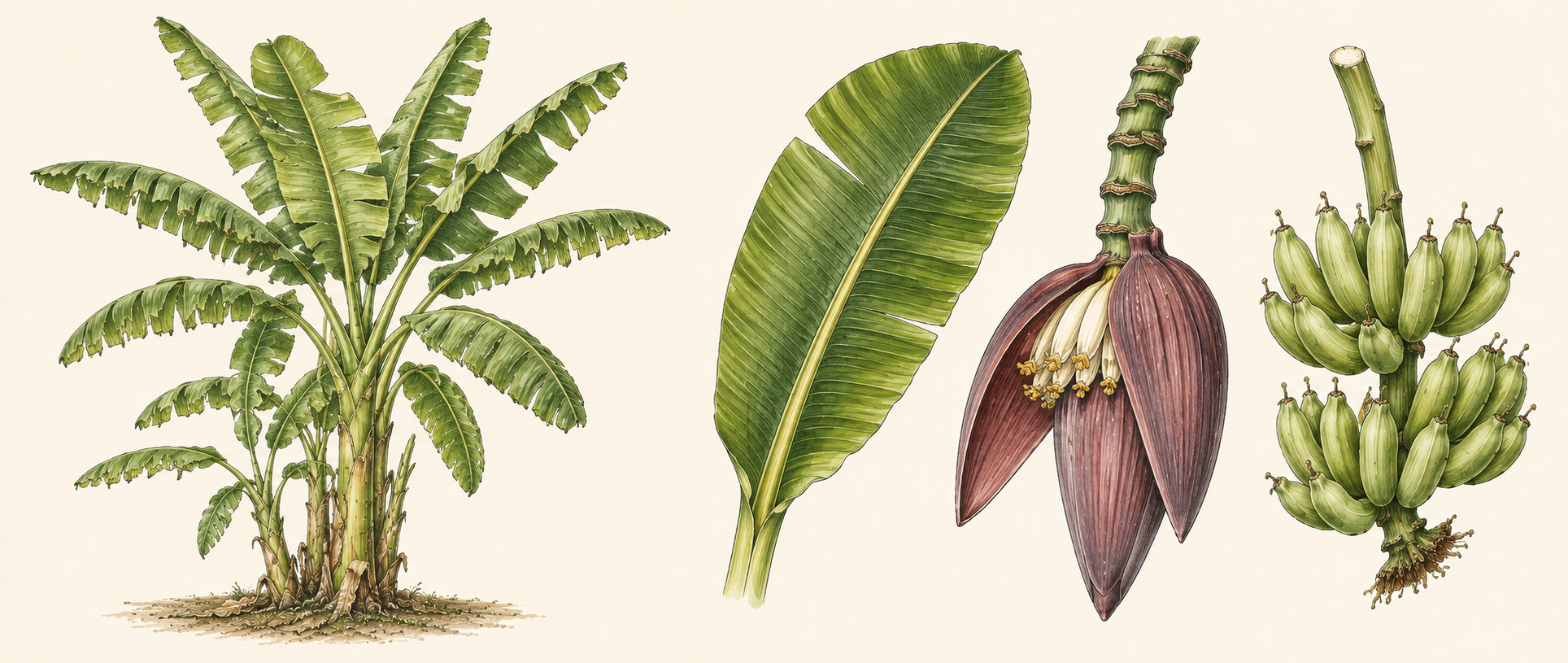
Growing
- Forest layer: Sub-canopy, effectively a giant herb rather than a true tree (no woody trunk).
- Growth habit & lifespan: Perennial clumping herb, each individual stem fruits once then dies back, replaced continuously by sucker growth from the base — the clump itself is effectively permanent if maintained.
- Size: 3-6m per stem depending on variety.
- Site preference: Full sun, wants rich, well-drained soil and good wind shelter — banana leaves shred badly in strong wind, worth siting away from exposed positions.
- Water needs / drought tolerance: High water needs, not drought-tolerant, a genuinely thirsty crop.
- Fruiting / flowering season: Large purple-red flower bud ("banana heart") emerges from the centre of a mature stem, developing into the fruit bunch over several months.
- Propagation: Division of suckers from an established clump — new plants establish quickly this way.
- Harvesting technique: Cut the whole bunch once fruit begins to plump and round out (not yet yellow) and ripen off the plant hanging in a shaded spot — waiting for full yellow on the stem risks bird/possum loss and splitting.
Permaculture Function
- Permaculture functions: A genuinely high-yield, fast-cycling food crop for a warm, sheltered, well-watered spot — often used as a "banana circle" nutrient-cycling hub, planted around a central compost/greywater pit that feeds the thirsty clump directly.
- Wildlife value: Flowers provide some nectar; ripening fruit is highly attractive to birds and possums if left exposed.
- Edibility / medicinal use: Fruit is a kitchen staple; the large leaves have traditional use as a natural food wrap/plate.
- Companion notes: Worth considering the banana circle pattern here specifically — cycling kitchen scraps or greywater into the clump's centre turns a hungry, thirsty crop into a genuine nutrient-cycling system component rather than just another bed needing separate inputs.
Safety & Control
- Toxicity: Not toxic; fruit is safely edible.
- Control method: Not applicable — retain and manage. Thin suckers periodically to keep the clump at a manageable size and productive rather than letting it spread unchecked.