
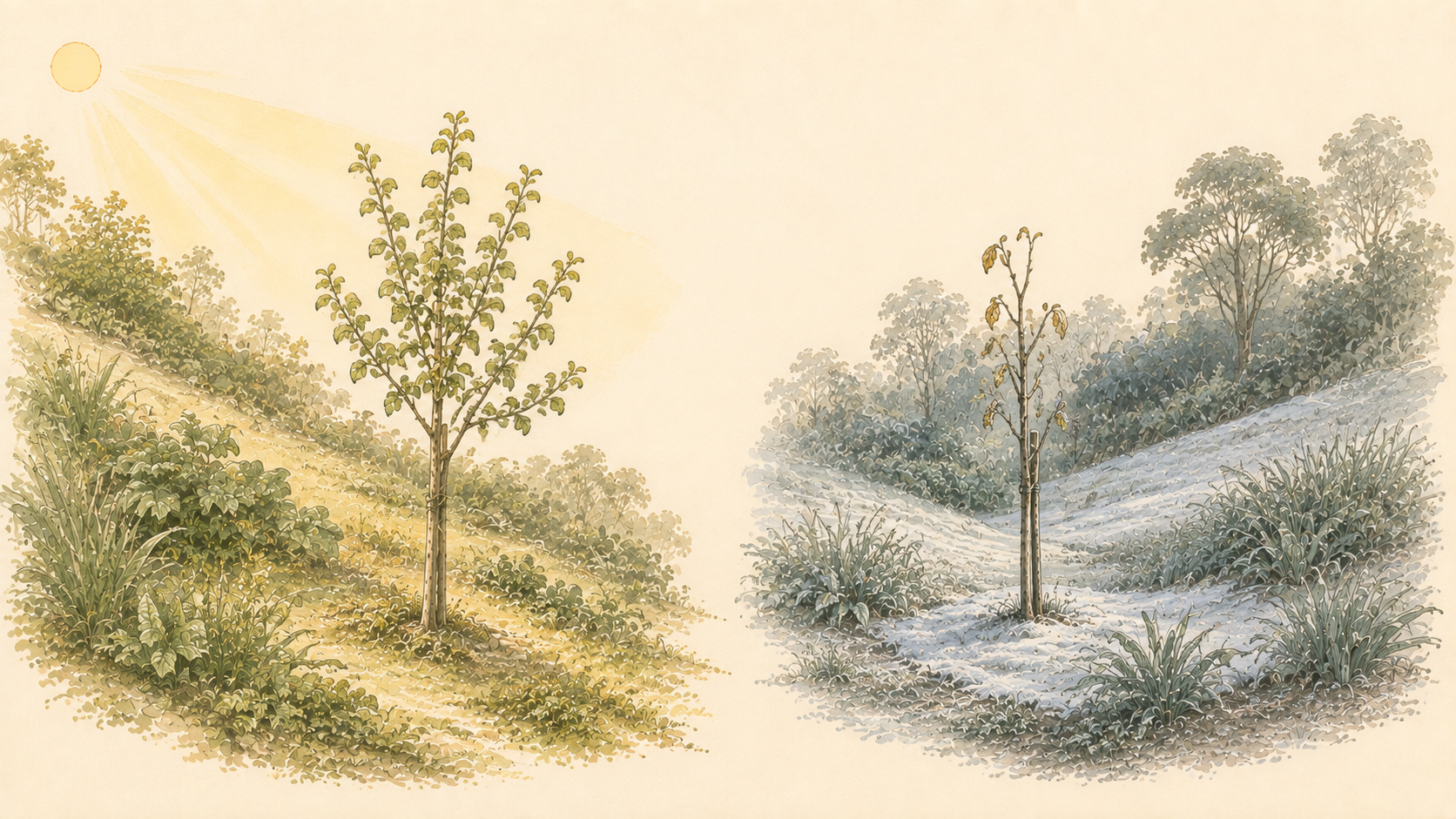
Frost doesn't fall evenly across a property the way rain does. It forms when the ground loses heat straight up into open sky on a clear, still night, faster than that heat can be replaced. Bill Mollison, one of permaculture's founders, had a memorable way of explaining it: a mouse living below ground in a tube barely loses any heat at all, while a mouse sitting on a mound in the open is exposed to the whole sky and loses heat fast. Two animals a few metres apart, living in completely different thermal worlds. Plants work the same way.
That's why a garden bed or a young tree can freeze solid on one part of a block and sit completely untouched ten metres away. The controlling factor isn't really the air temperature. It's how much open sky a given spot can "see." A sheltered dip surrounded by taller planting, or a bed set slightly below grade with steep sides, radiates far less heat away overnight than the same spot left flat and exposed. As a rough guide, a sheltered clearing or pit works best when it's roughly twice as wide as it's deep. Push much past that, especially past around 30 metres across in a treed setting, and it stops sheltering and starts collecting cold air instead.
Where frost actually pools
Cold air is heavier than warm air, so it drains downhill overnight and pools wherever it runs out of somewhere to go: valley floors, low hollows, the flattest part of a block. The mid-slope, by contrast, tends to be the mildest spot on the whole property: warm air rising past it from below, cold air draining away past it toward the bottom. That band even has a name, a thermal belt, and it's usually the best place on a sloped property for both a house and food production, once it's actually been mapped rather than guessed at.
Mapping it doesn't need anything technical. Watching how tree canopies lean and thicken on one side over the years is a slow-motion record of the cold and wind they've grown against. A couple of cheap min/max thermometers left in different spots across a few seasons will do the rest.
The elevation bonus most people miss
There's also a genuine bonus hiding in a sloped block: roughly every 100 metres of height a property gains behaves like moving about one degree further from the equator. A block with both a hill and a flat can grow a noticeably wider range of species than its official climate zone suggests: cooler-climate plants further up, warmer-climate plants down on the flat, on the same title.
None of this means avoiding low ground altogether. Plenty of low-lying land is still worth using well. It means being deliberate about what goes where: frost-tender young trees and food crops sited on the thermal belt or given real shelter, and the coldest low pockets used for whatever's genuinely frost-hardy, rather than finding out the hard way after a winter's replanting bill.