
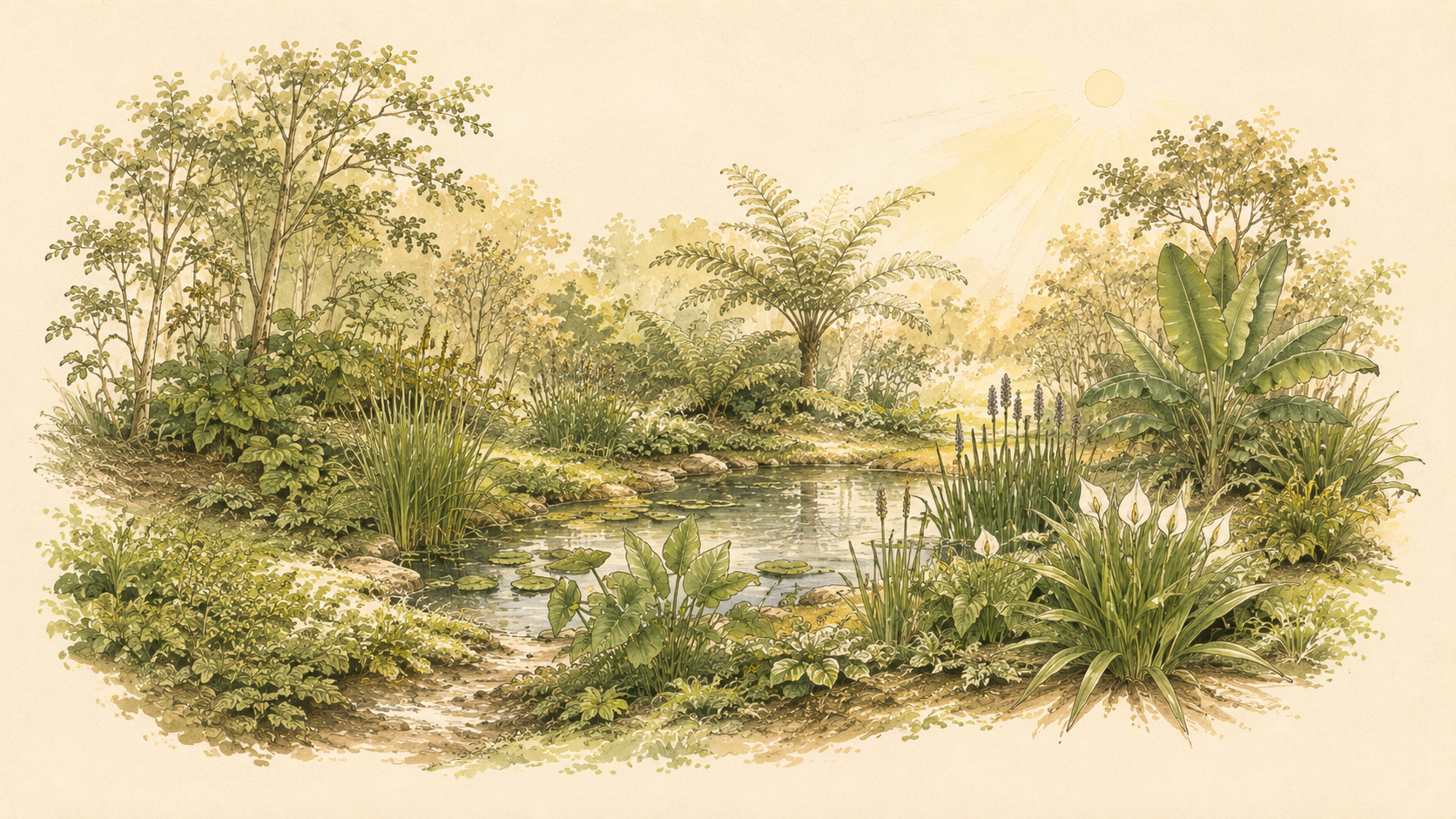
Almost every property has one: a corner that stays boggy for weeks after rain, a west-facing wall that turns the patio into an oven every afternoon, a slope too steep to mow comfortably. The usual response is to treat it as a defect: drain it, shade it, terrace it away. Understandable, but it skips a more useful question. What is this spot actually good at, that nothing else on the property is?
That question is close to the founding idea of permaculture design, usually put more bluntly: the problem is the solution. Not as a slogan, but as a genuine design habit. A "problem" is almost always a resource that hasn't found its match yet.
An old line that still holds up
One of the field's founders was once asked about a garden overrun with snails. His answer wasn't a pest-control tip. It was that there wasn't an excess of snails. There was a deficiency of ducks. Add the right element, and what looked like a plague becomes a feed source and a maintenance job that does itself.
A pollutant is simply an output of one part of a system that isn't being used productively by any other part of it.
Flip that around and it's a design method: for every awkward feature on a site, ask what element would actually want that exact condition. A few examples that come up constantly on real Southeast Queensland blocks:
- The scorching west wall nobody wants to sit near in summer is often the single best spot on the property for espaliered fig, mulberry, or other fruit that wants exactly that heat load, turning a liability into vertical growing space that would otherwise go unused.
- The boggy low corner that never quite dries out is usually a fight not worth winning with drainage. Left alone, or worked with, it's often a natural home for a wildlife pond, water-loving edible plants, or (on a larger block) ducks or geese, replacing a maintenance headache with a yield.
- The steep, awkward-to-mow slope is exactly where lawn was never the right answer in the first place. Terraced plantings or a food forest on contour turn "hard to maintain" into "barely needs mowing at all," because it stops being lawn.
Why this matters more than it sounds
This isn't just a reframing trick. It changes what a design actually costs you over time. Fighting a site's natural conditions (draining what wants to stay wet, forcing lawn onto a slope, fertilising shade-starved soil to keep grass alive under a tree) is expensive and never really finishes. Working with what a spot is already doing usually costs less to build and gets easier to maintain as it matures, not harder.
Before we design anything, we walk a site looking specifically for these "problems," because they're usually the most interesting part of the brief, not the part to design around.