
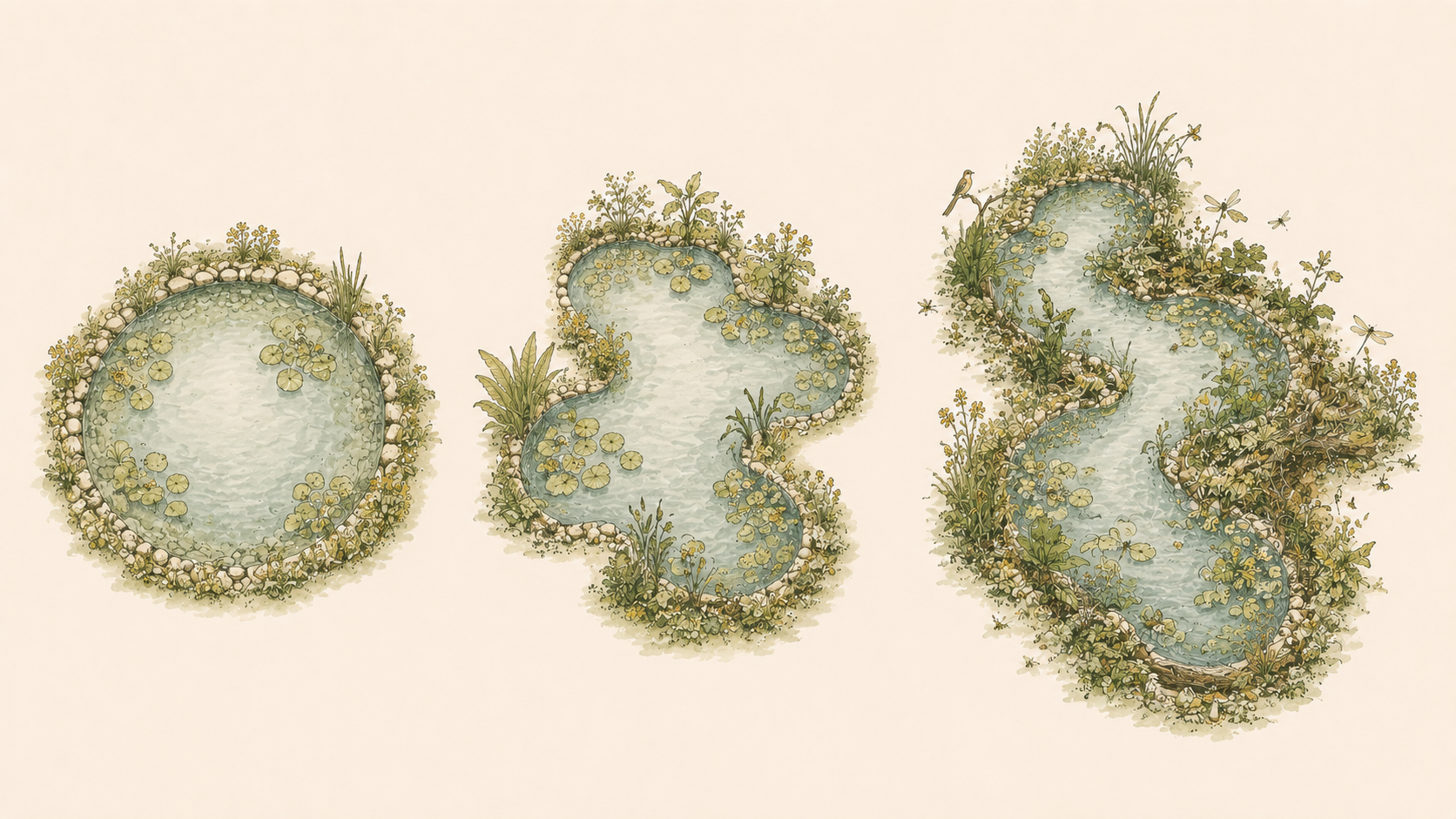
If you are putting a pond in, almost every decision in front of you costs money. Size costs money. Depth costs money. Liner, pump, planting, fencing, all of it costs money. Shape does not. An excavator digging a long thin hole and an excavator digging a round one cost about the same, and the difference in what the pond can produce afterwards is not small.
Three ponds, one difference
There is a well known comparison in permaculture teaching that makes this concrete. Take three ponds. Give them the same surface area, the same depth, the same volume, the same water quality. Change only the outline.
| Pond | Shape | Perimeter |
|---|---|---|
| A | Circular, 5m radius | about 32m |
| B | 37.5m by 2m | 81m |
| C | 75m by 1m | 153m |
All three hold 75 square metres of water. Pond C has almost five times the edge of Pond A, for the same hole.
Why edge is where the yield lives
Almost nothing useful happens in the middle of a pond. The productive band is the margin, where light reaches the bottom, where plants root, where insects lay, where frogs and fish shelter and feed. Most of what feeds pond life either grows at the edge or lives on something that does.
So when you stretch the outline, you are not making the pond prettier. You are enlarging the only part of it that produces. On the comparison above, Pond B yields roughly two and a half times Pond A's natural food supply, and Pond C around five times.
The middle of a pond is storage. The edge is the garden.
The effect compounds
Edge multiplies with everything else you do to the pond, rather than simply adding to it. Plant a half metre band of vegetation overhanging the water and on the round pond it shades and feeds a modest ring around the outside. On the narrow pond, half a metre from each side reaches clear across the whole thing. The same planting, the same cost, roughly three times the effect.
The same goes for flexibility later on. A long narrow pond can be partitioned into sections, which lets you run different water depths, different plantings, or different uses in the same body of water. A circle is one thing and stays one thing.
When a circle is still the right answer
This is not an argument that every pond should be a trench. If what you need is water storage, a compact shape with more volume relative to its surface loses less to evaporation and takes up less of your block. Long narrow ponds also sit far more naturally along a contour on sloping ground than round ones do, which on some sites is the deciding factor before yield ever comes into it.
The question is what the water is for. Storage and production pull the shape in different directions, and it is worth being honest about which one you are actually building before the machine arrives.
Why this belongs in the plan, not the build
Nearly everything else about a pond can be changed later. You can plant the margins next year, add fish the year after, put in a pump when you get around to it. Shape is the one decision you make once, on the day of excavation, and cannot revisit without digging the whole thing again.
That is exactly the kind of decision worth spending design time on. It costs nothing to specify and everything to get wrong.