
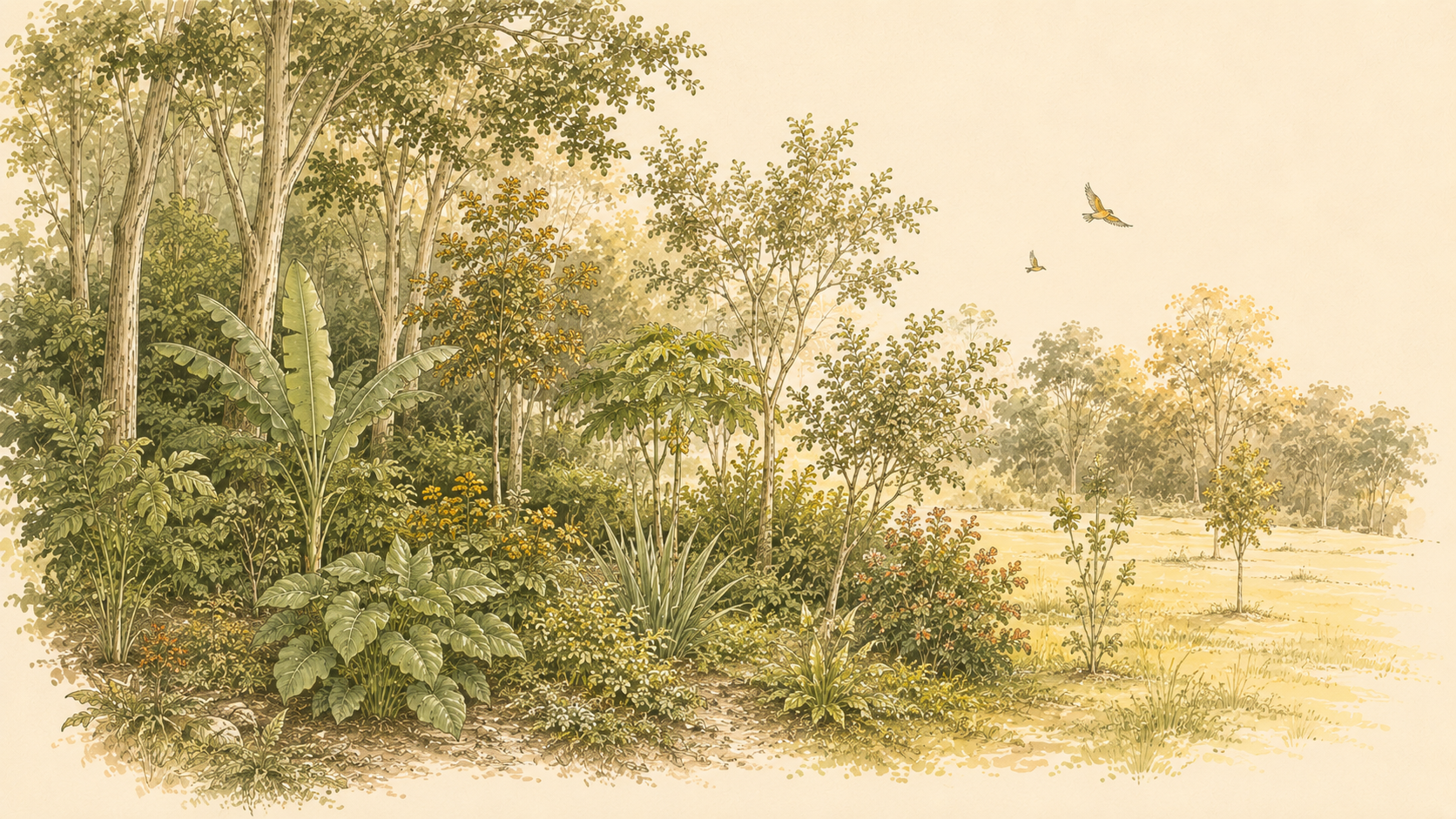
Stand in the exact centre of a mown lawn, or the middle of a bare paddock, and you're standing in the least interesting square metre on the property. Walk to where two different things meet instead: forest and clearing, garden bed and path, pond and bank. That's where the activity actually is. More species, more interaction, more going on per square metre than almost anywhere else on site.
Ecologists call this the edge effect, and it's one of the more reliably useful ideas in land design: the boundary between two different conditions is usually more productive than either condition on its own. A food forest's most productive layer often isn't the canopy or the open garden bed. It's the sunny, sheltered strip where the two meet. A pond's most active zone isn't the deep water or the dry bank. It's the shallow margin between them.
"Leave it wild" isn't the same as "leave it alone"
This matters most on acreage properties with a bush or forest boundary, because the most common brief we hear is some version of "just leave the back forest alone." It's a reasonable instinct, but a forest edge left with zero management doesn't stay put. It gets overrun, slowly, by whatever's most opportunistic locally.
There's a well-documented example of this from rural Japan, where volunteer land-care groups spend real effort defending centuries-old terrace walls from invading bamboo, walls that had stood for three hundred and fifty years, being pushed apart within decades once nobody was managing that specific boundary. Here in Southeast Queensland it's the same problem with different species: lantana, camphor laurel, and privet are exactly what moves in on an unmanaged forest edge, not gently, and not reversibly once established.
The boundary between cultivated land and forest isn't a line to draw once and ignore. It's an edge that needs tending, the same way a garden bed does, just on a longer timescale.
Designing the edge on purpose
Once you treat a forest edge as something to actively shape rather than a line to leave alone, it becomes one of the most useful zones on the whole property: a place for shade-tolerant understory planting, a windbreak that also produces, or simply a managed buffer that keeps the weed problem from ever establishing in the first place. The same edge-effect thinking applies at a much smaller scale too: the border of a vegetable bed, the margin of a dam, the line where a driveway meets a planting strip. Every one of these is an opportunity most designs waste by treating it as a boundary instead of a place in its own right.
When we walk a new site, we're not just looking at the open ground. We're looking specifically at every edge on the property, because that's usually where the best opportunities, and the most urgent problems, are both hiding.