
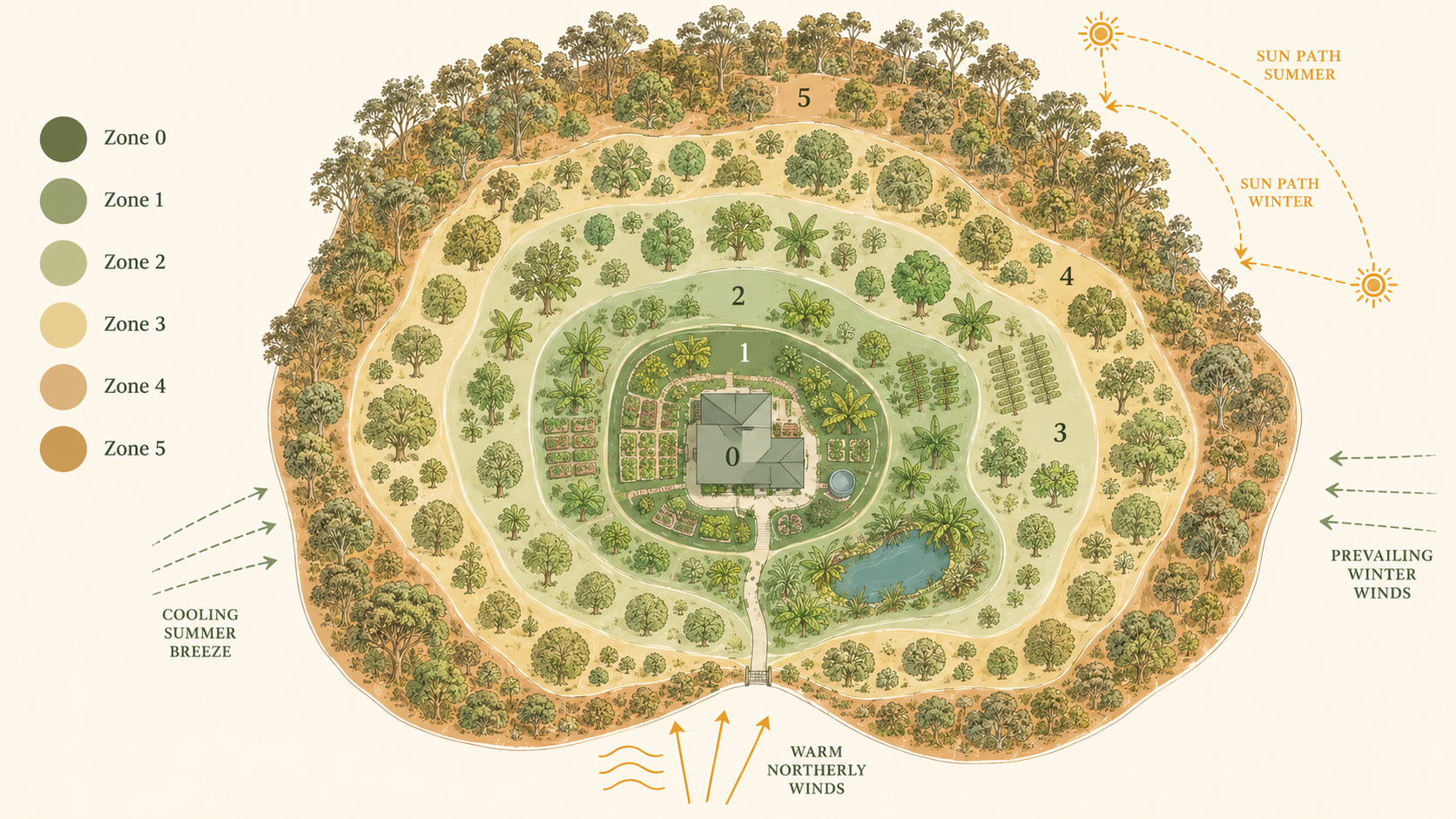
Before we plant anything, we draw two maps. Neither one has a single plant on it yet, and they're the most important part of the whole design.
Zones: how often do you actually go there?
Picture your property as a series of rings spreading out from your back door. The closest ring is where the things you visit constantly belong: herbs, a few vegetable beds, anything you want to harvest on the way to make dinner. Further out, things that need less attention: fruit trees, main crops. Further still, broader-scale production, larger animals, windbreaks. At the very edge, land you leave alone on purpose, because every good design needs a reference point for what "wild" actually looks like on your specific site.
The test we use for placing anything is one question, asked two ways: how often do you need to visit it, and how often does it need you to visit it? Match those two numbers to its distance from the house, and maintenance stops feeling like a chore, because you were never walking further than the job actually required.
Sectors: what's arriving at your site from outside?
Zones handle what's inside the fence. Sectors handle what arrives from outside it: sun angle, prevailing wind, rain, fire risk, even wildlife movement. We map these as directional wedges across the site, not because it looks technical, but because it tells us exactly where a windbreak needs to go, where a hedge should sit to block a hot westerly, and where not to put anything flammable relative to fire-prone bushland.
Every element should serve more than one function, and every important function should be backed up by more than one element.
A free source of energy most designs ignore
Slope is doing work whether you use it or not. Water runs downhill for free, and hot air and hot water rise for free too, which means a header tank sited above where the water's needed doesn't need a pump to get it there. Where a site is genuinely flat, we'll sometimes create a small amount of artificial fall on purpose (a raised stand, a slightly excavated hollow) just to put that free energy back to work.