
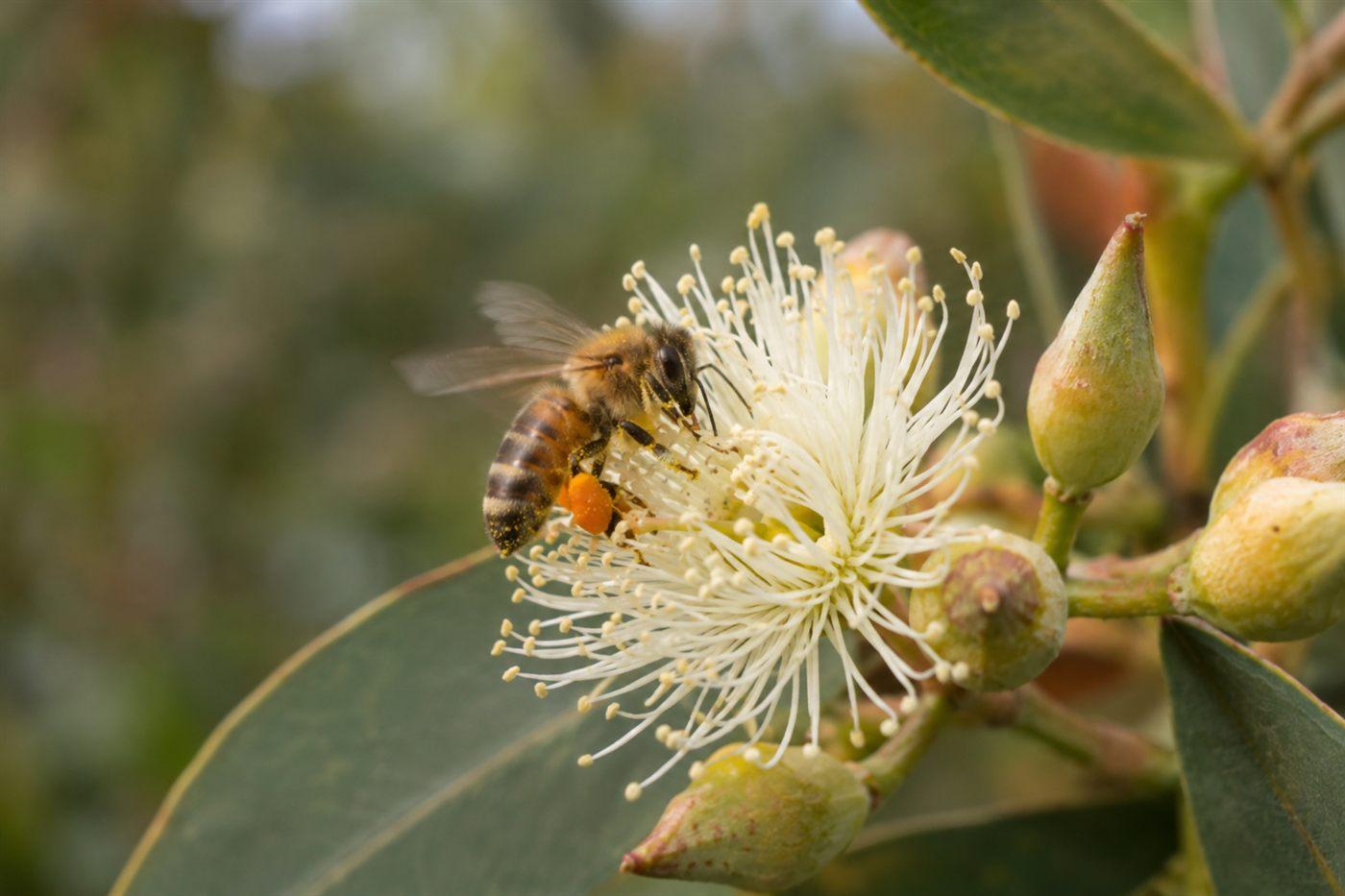
Pollination comes up on nearly every site visit, and it almost always arrives in the same shape. Someone points at a corner of the yard and says they have been thinking about putting a hive there. It is a good instinct. The hive is also usually the smallest part of the answer, and the part that matters least in the order things should be decided.
Here is the thing that reframed this for us. The question is not where the box goes. It is how wide a circle the insect inside it works, because that circle decides where every flower on the property should be.
Most of the pollination is already happening
In 2013 a team led by Lucas Garibaldi published a study in Science covering 41 crop systems around the world, looking at what actually drove fruit set. Visits by wild insects were positively associated with fruit set in every single one of those 41 systems. Visits by managed honey bees produced a significant increase in only 14 percent of them. And when they compared like for like, an increase in wild insect visits lifted fruit set by about twice as much as the same increase in honey bee visits.1
The two effects turned out to be independent of each other, which is the detail worth holding onto. Managed hives added to what the wild insects were doing. They did not replace it. A property with no habitat and one hive is a very different proposition from a property with good habitat and no hive, and the research says the second one is in better shape.
The hive supplements the wild insects. It does not stand in for them.
So the first pollination decision on any block is not about bee boxes at all. It is about whether there is continuous flower, undisturbed ground, standing dead wood, and water for the insects that are already there. Around three quarters of the world's leading food crops benefit from animal pollination to some degree,2 and on a backyard or acreage scale most of that work is being done by things you have never counted.
Two very different circles
Now the part that actually changes a drawing. European honey bees and Australian native stingless bees do not operate at anything like the same scale.
| European honey bee | Native stingless bee | |
|---|---|---|
| Usual working range | Most foraging within about 3km, with around 75 percent of foragers staying inside 1km3 | Generally within about 500m of the nest4 |
| Typical measured range | Flights of 6km and beyond are well documented, and up to 12km has been recorded3 | Typical homing range measured at 333m, maximum 712m4 |
| Young foragers | Only a few hundred metres at first3 | Short range throughout |
Sit with those numbers for a moment and the design consequence falls out on its own.
A honey bee hive forages the neighbourhood, not your block. At a 3km working radius, a hive in a Gold Coast hinterland backyard is drawing on something like 2,800 hectares, and you control a vanishingly small slice of it. You cannot feed that colony from a garden bed. What your planting can do is fill the gaps in the local calendar, the weeks when nothing in the surrounding bush or suburb is flowering. That is a genuinely useful job and it is a different job from "providing forage."
A native stingless bee hive forages your block and your close neighbours. A 500 metre radius works out to about 78 hectares, which is 36 times less ground than the honey bee circle. Worth being straight about what that does and does not mean. It is not all inside your fence line. A two acre block is only about one percent of a 500 metre circle, and a ten acre block around five percent. What changes is that your planting goes from being a rounding error to being a measurable share of the colony's whole food supply, and the rest of its range is the street and the paddocks next door instead of half a suburb. That is a range you can actually see, walk, and account for. It is also why these bees are now managed commercially for macadamia and lychee pollination in Queensland and northern New South Wales, where orchard blocks suit that tight radius.4
Every circle above is drawn to one true scale, centred on the same hive. The outer one runs off all four corners because a honey bee's working range does not fit on the page its block is drawn on. Area is what matters, not radius: double the radius and you quadruple the ground.
Clump the flowers, do not scatter them
One bed with forty flowering plants of three species outperforms forty single plants dotted through a mixed garden. A foraging bee tends to work one species at a time and keeps returning to the patch it found, so a dense block of one flower is cheap for her to harvest and a scattered population of the same plant is expensive. Bill Mollison made this point in the Designer's Manual and set a rough target of 35 main forage species across the season, specifically because any one species will have a bad year.5
Mollison also had a counterintuitive rule about placement: site bee forage at 100 metres or more from the hive, not right up against it, on the reasoning that the flight home does some of the work of concentrating nectar into honey.5 We treat that one as a sensible design preference rather than a hard constraint, but it does usefully kill the instinct to crowd everything around the hive stand.
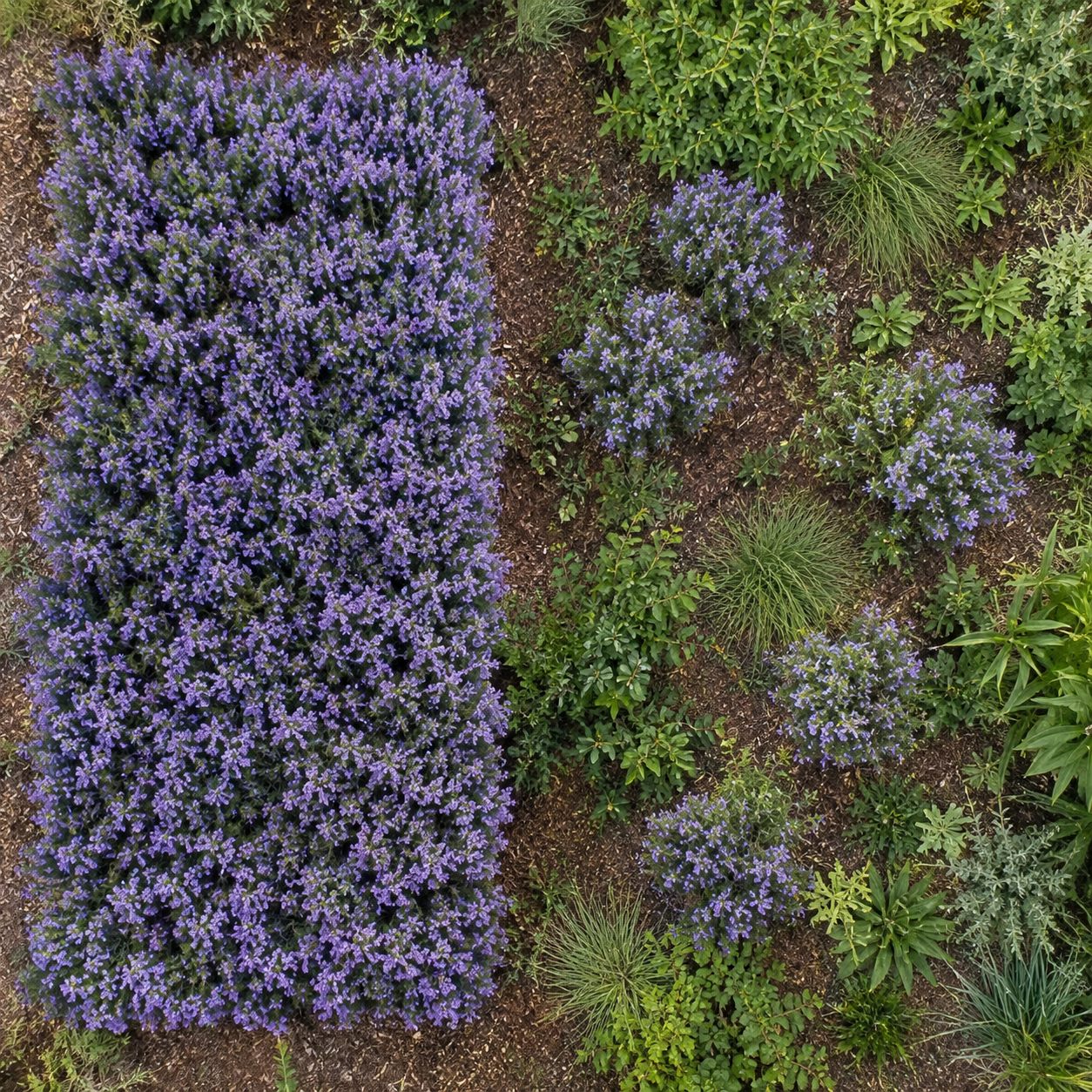
Same plant, similar number of flowers, two very different jobs to harvest. The block on the left is one stop. The right hand side is a dozen separate decisions.
The limit is weather, not distance
Bees are not held back by how far the flowers are nearly as often as they are held back by conditions. Flight more or less stops below about 10 degrees, and foraging is most efficient somewhere between 20 and 30 degrees. In one study, honey collection stopped entirely once the daily mean dropped under 18 degrees.6
Wind matters even more, and it is the factor people never plan for. Foraging efficiency starts falling away in moderate wind, and at around 40 kilometres per hour it stops altogether.6 On an exposed block that is a lot of lost days in a season, and the fix is cheap. A low flowering hedge, half a metre to a metre high, running from the hive out toward the forage area, gives the bees a sheltered corridor to work in.5 Rosemary, acacia, thyme and catmint all do the job and all flower while they are doing it, so the shelter and the forage are the same planting.
Heat is the other end of the same problem. A colony cools itself by fanning, and a hive in full afternoon sun puts a share of its workforce on air conditioning duty instead of out foraging. Afternoon shade on a Queensland hive is not a comfort measure.
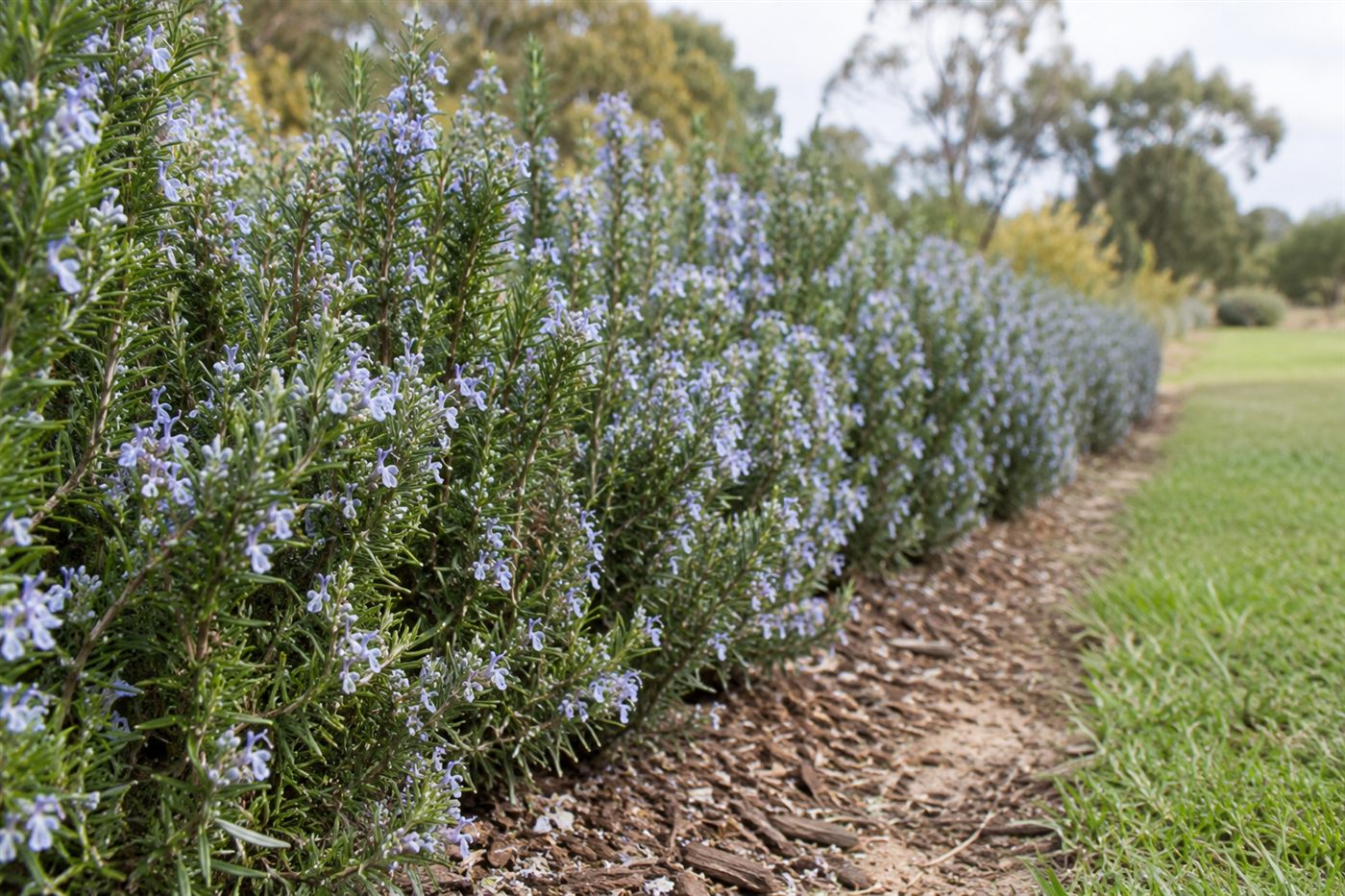
A rosemary hedge like this is doing two jobs at once. It breaks the wind at the height the bees are flying, and it feeds them while they shelter in it.
Pollen, not just nectar
Nectar is the carbohydrate. Pollen is the protein, and it is what a colony needs to raise the next generation of workers. The orange lump you see packed on a bee's back leg is a pollen basket, and that is the part feeding the brood. A property can look like it is covered in flower and still be short of early season pollen, which is exactly when the colony is trying to build numbers back up.5
This is where the plan earns its keep, because the gap is almost always seasonal rather than total. Walk the property once a month for a year and write down what is actually in flower. The empty rows in that list are your planting brief, and they are usually two or three weeks long and in the same place every year.
Water, and how bees drown
A clustered hive site gets through a surprising volume of water in hot weather, all of it used for cooling. Bees also cannot land on open water. They need something to stand on while they drink, and without it they drown in numbers at the edge of a pond or a dog bowl. A soaked hessian mat or coir mat laid into the shallow margin of a pond solves it for nothing.5
One further detail from the same source, and it is the kind of thing you only learn from someone who has watched it happen: small troughs and ponds without resident dragonflies cost fewer bees, because dragonflies are efficient predators of them.5 That is not a reason to be hostile to dragonflies. It is a reason to put the drinking station somewhere other than the main pond.
The honest part: varroa changed the deal
Varroa mite was first detected in Australia in New South Wales in June 2022. Eradication was abandoned in September 2023 and the country moved to managing it instead. It was confirmed in Queensland for the first time on 3 March 2025, and Biosecurity Queensland now describes detections across many council areas, along with the emergence of resistance to synthetic miticides.7
What that means practically is that keeping European honey bees in southeast Queensland is now an ongoing monitoring and treatment commitment. It is a real and rewarding hobby and it is no longer a thing you set up and leave in the corner of the paddock. Anyone taking it on should go in with a local beekeeping club and an integrated pest management plan from the start.
It also sharpens the argument at the top of this article. If your entire pollination strategy is one managed colony, your strategy has a single point of failure that is now under active pressure. Habitat for wild insects does not have that problem, and it is the cheaper half of the work.
The paperwork, briefly
In Queensland you are required to register as a biosecurity entity if you keep one or more European honey bee hives. One hive counts. Registration is free for hobbyists and runs for three years, and you are issued a single hive identification number covering all the hives you own. At least one hive in every fifty has to carry that number in block letters a minimum of 25mm high, centred on the front of the box.8
Separately, local councils set their own rules on how many hives a residential block can carry and how far they must sit from boundaries, and those rules vary from one council to the next. Native stingless bees sit outside most of this. Check both the state registration and your own council before you buy anything.
What this looks like on a plan
- Decide which bee first. Everything downstream of that changes with the answer, and on most suburban and small acreage blocks the native stingless hive is the better fit.
- Build the habitat before the hive. Continuous flower, undisturbed ground, standing dead timber, water. This is the part the research says carries the most weight.
- Map the flowering calendar by month and plant for the empty weeks, not for abundance in general.
- Plant forage in blocks of one species, not as singles through a mixed bed.
- Give the hive afternoon shade and a sheltered flight corridor out to the forage.
- Put a standing surface in the water, wherever the water is.
- If it is honey bees, register before the bees arrive and join a club in the same week.
None of that is expensive. Most of it is a question of where things go, which is the part of a property that is almost free to get right at the drawing stage and costly to fix once everything is planted.
Where this comes from
- Garibaldi, L.A. et al. (2013). "Wild Pollinators Enhance Fruit Set of Crops Regardless of Honey Bee Abundance." Science 339(6127), 1608-1611. science.org
- Klein, A.M. et al. (2007). "Importance of pollinators in changing landscapes for world crops." Proceedings of the Royal Society B 274(1608), 303-313.
- British Columbia Ministry of Agriculture, Bee Behaviour During Foraging, Apiculture Factsheet 111; Beekman, M. and Ratnieks, F.L.W. (2000). "Long range foraging by the honey bee, Apis mellifera L." Functional Ecology 14(4), 490-496. gov.bc.ca factsheet
- Smith, J.P., Heard, T.A., Beekman, M. and Gloag, R. (2017). "Flight range of the Australian stingless bee Tetragonula carbonaria (Hymenoptera: Apidae)." Austral Entomology. doi 10.1111/aen.12206. On commercial use and crop fidelity in Queensland macadamia orchards: "The Impact of Colony Deployment Timing on Tetragonula carbonaria Crop Fidelity and Resource Use in Macadamia Orchards," Plants 14(15), 2313 (2025). doi 10.3390/plants14152313
- Mollison, B. (1988). Permaculture: A Designer's Manual, Chapter 12, Free Range Forage Systems, pp. 427-431.
- Review of short term weather impacts on honey production (2025), PMC; University of Maine Cooperative Extension, Honeybee Flight Activity Index. pmc.ncbi.nlm.nih.gov
- Biosecurity Queensland, Varroa mite detections in Queensland. business.qld.gov.au
- Business Queensland, Hive registration and branding. business.qld.gov.au
Regulatory details above were current at time of writing, October 2026. Biosecurity requirements change, so confirm with Biosecurity Queensland and your local council before you act on them.