
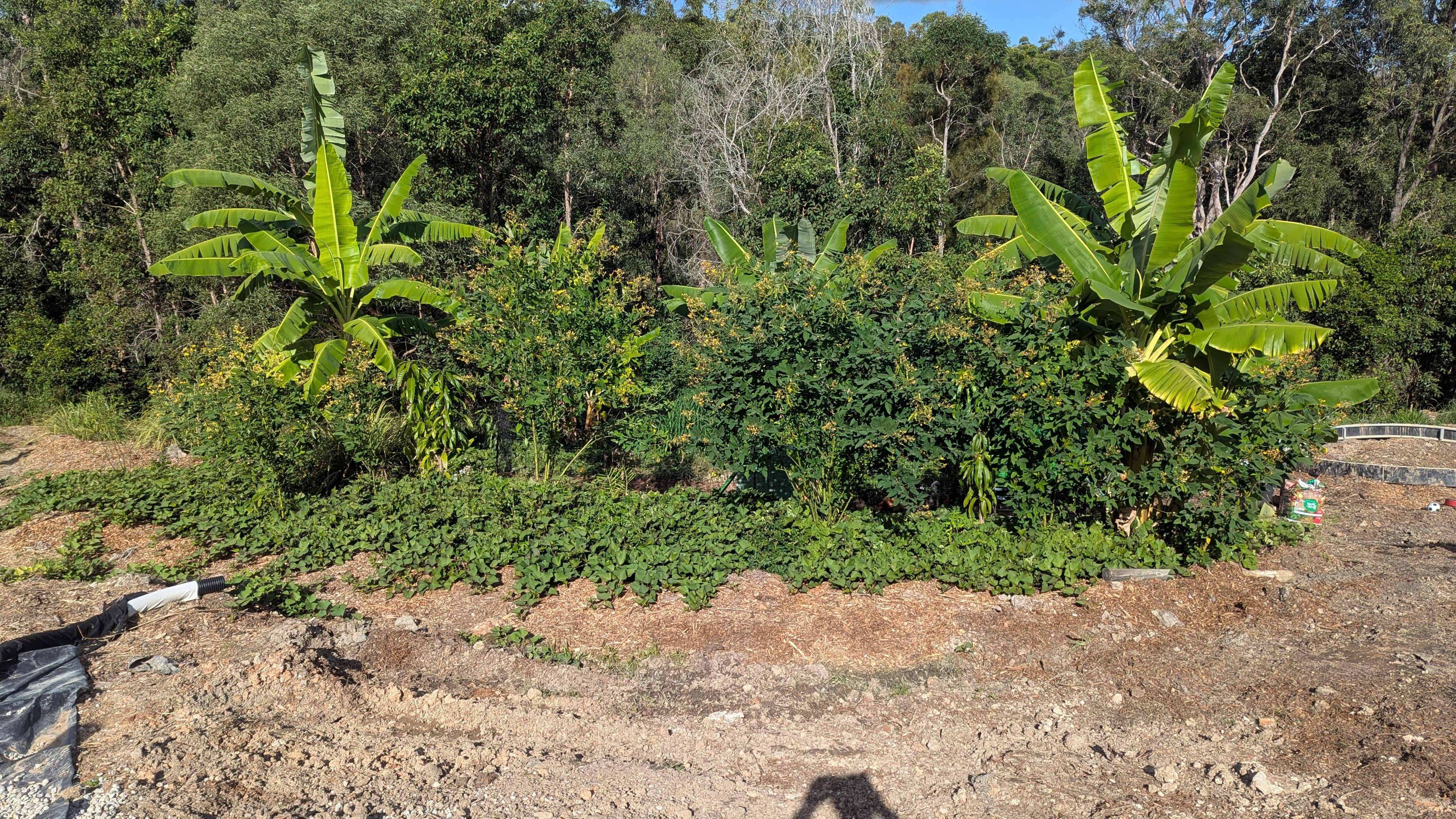
A single fruit tree, given the right companions planted around its base, will out-produce the same tree stuck alone in a lawn. A food forest takes that same idea and runs it across a whole section of a property: canopy trees, smaller trees filling the gaps beneath them, shrubs, herbs, groundcovers, and vines, each one occupying a different layer of the same space and feeding or supporting something else in the system.
The mistake people make is picturing this as complicated, or overgrown. It's closer to the opposite. Layer follows structure. The tallest, longest-lived trees go in first, spaced for the size they'll be in twenty years, not the size they are in a pot. Everything smaller comes after, tucked into the light gaps that structure creates as it grows. Climbers and vines are the very last thing added, once there's an actual framework strong enough to carry them.
Existing trees are a head start, not an obstacle
Don't clear a block of established trees to start a food forest from a blank slate, even if those trees are currently purely ornamental. Mature canopy and root structure is something that would otherwise take a decade to grow. The better move is to read what's already there, retain the trees doing real work, and build the new layers underneath and around them.
It keeps changing after it's planted
The other thing that catches people out: a food forest needs re-reading over time, not just planting once and walking away. Early on, before the canopy has closed over, the lower layers want sun-loving species. As the trees mature and the canopy thickens, that same ground gets shadier, and whatever thrived there in year one starts to struggle. A food forest that's still being adjusted five years in isn't behind schedule. That's what a working one actually looks like.
On sites near a wildlife corridor or a roosting colony, species selection for the fruiting layer can also be tuned around what that wildlife is and isn't drawn to. Choosing naturally low-attraction fruiting and nutting species means the system doesn't need netting or fencing to protect a harvest, which is a lot less ongoing maintenance than building infrastructure to keep wildlife out.